
Lead Flashing Repairs in Warrington: What Goes Wrong and What It Costs to Fix
Lead flashing is responsible for a disproportionately large share of roof leaks in Warrington's residential housing stock. As a town with significant Victorian and Edwardian terracing - particularly in areas like Stockton Heath, Latchford, and Orford - and a large proportion of semi-detached properties from the interwar and post-war periods, Warrington has exactly the type of housing where lead flashings are universal and where original lead installations are now reaching or exceeding their effective working life. The National Federation of Roofing Contractors estimates that defective lead flashings account for approximately 25-30% of all domestic roof leak diagnoses across the UK, and the proportion is higher in areas with a high density of period housing like Warrington's inner residential streets. When lead fails, it usually fails gradually and invisibly - which means the problem is already significant by the time it appears as a damp patch inside the property.
Where Lead Flashing Is Found on Warrington Roofs
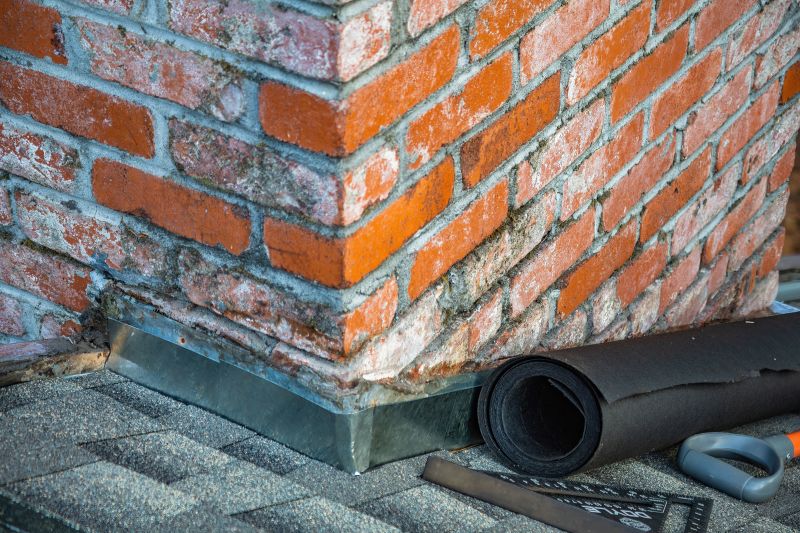
Lead flashing appears at every junction between the roof surface and a vertical element.
On a chimney, it's the most complex lead work on the house. Step flashings run up both sides of the stack; a back gutter runs across the high side where water collects behind the stack; a front apron covers the lower face. Any one of these can fail independently, and on older Warrington properties they often fail together.
Valleys are where two roof slopes meet in a V. Lead lines the valley to carry water down to the guttering. Old code 3 valley lead is particularly prone to cracking under the thermal movement it experiences through the year.
Abutment flashings run where the roof meets a wall - such as at the joint between a rear extension and the main house. These are common in Warrington's older terraces where rear additions have been built at various points. There are also verge and hip flashings at the sides and hips where roof planes meet, and flat roof perimeter flashings where the covering of a flat roof meets the upstand at a parapet wall.
Northwest Roofing Contractors carries out lead flashing repairs and replacement across Warrington and the surrounding area.
Why Lead Flashing Fails in Warrington
Lead expands significantly when heated and contracts when cooled. A piece of lead flashing on a south-facing chimney in Warrington experiences temperature swings of 50-60°C or more between winter overnight lows and summer midday highs. Over many years, this repeated movement causes fatigue cracking - particularly in thinner-gauge lead and at fixed points where the lead can't move freely.
Detachment from the mortar chase is the other common failure mode. Lead step and abutment flashings are typically fixed into the mortar joint of the adjacent brickwork. Over time, the mortar holding the top edge degrades. The flashing pulls away, rain drives in behind it, and water gets into the roof structure or wall cavity.
Code-weight matters too. Lead is categorised by code number - code 3 is thinner, code 5 is the current standard. Earlier decades used code 3 or even code 2 in positions where the specification should have been code 4 or 5. Thin lead is more vulnerable to fatigue cracking and has a shorter service life. Physical damage from foot traffic, falling branches, or debris accumulating in valleys can also cause direct lead failure.
When Lead Flashing Fails - What You See Inside
The interior symptom of lead flashing failure is typically a damp patch on a wall or ceiling, often at a corner or near a chimney breast. Damp that appears in periods of heavy Warrington rain - the town receives around 700mm of rainfall per year - and dries out in dry weather is a classic sign of an active water ingress point, rather than condensation (which tends to be more consistent and not weather-dependent).
Damp patches near chimney breasts on upper floors or in loft spaces are particularly associated with chimney flashing failure. We've covered the full range of roof-related damp causes in our Runcorn roof repairs guide, which runs through how to diagnose whether a leak is coming from flashings, tiles, or elsewhere.
Lead Flashing Repair Options - What the Work Involves

Strip sealant patching. Products like Flashband or similar bituminous strip materials can be applied to localised sections of failing flashing as a temporary fix. They typically last 3-5 years before the edges lift and the problem resumes. Useful in an emergency or as a stopgap before scheduled work, but not a substitute for properly specified lead.
Re-dressing and re-pointing. Where lead has pulled away from a mortar chase but is otherwise undamaged, the lead can sometimes be dressed back into the joint and re-pointed with fresh mortar. This is a genuine repair if the lead itself is in good condition; it's a temporary fix if the lead is fatigued or cracked.
Section replacement. Where one part of a lead installation has failed but the rest is sound, the damaged section can be cut out and new lead spliced in. Requires experience to achieve watertight joints at the splices.
Full lead replacement. The correct solution when the lead is old, thin-gauge, or has multiple failure points. New code 4 or code 5 lead, correctly specified and installed, should last 50+ years. This is the right answer for chimneys where the existing lead is original Victorian or interwar installation.
What Lead Flashing Repairs Cost in Warrington

Strip sealant patch (temporary, emergency): £80 - £200 including labour.
Re-dress and re-point existing lead at chimney: £200 - £400, scaffold additional.
Replace chimney step flashings (both sides, new code 4 lead): £400 - £700.
Full chimney lead set (step, back gutter, front apron, new lead): £600 - £1,100.
Valley lead replacement (per linear metre, code 5 lead): £80 - £160 per metre.
Abutment flashing replacement (per linear metre): £70 - £140 per metre.
Scaffold for Warrington property (typical two-storey semi): £500 - £900 additional.
Note that scaffold is often the largest single cost in lead flashing repairs, and combining lead work with other roof repairs (tile replacement, ridge repointing) in a single scaffold visit reduces the overall cost significantly compared to separate visits.
FAQ
Q: How do I know if my Warrington roof leak is from the lead flashing?
Water ingress that appears close to a chimney breast, roof-wall junction, or valley line, and that is clearly weather-dependent (worse in rain, absent in dry periods), points to flashing failure rather than missing tiles or felt failure. A roofer can confirm with an inspection from scaffold or a drone survey.
Q: Can lead flashing be repaired rather than replaced on a Warrington property?
Sometimes yes. If the lead is in good condition but has pulled away from the mortar chase, re-dressing and re-pointing can give another decade or more of service. If the lead is cracked, thinning, or very old (pre-1970s installations are often code 3 or thinner), replacement with properly specified code 4-5 lead is the better long-term answer.
Q: How long should new lead flashing last on a Warrington property?
Correctly specified code 4 or code 5 lead, properly installed with correct lap and fixing, should last 50 years or more. The lifespan depends partly on the specification and partly on the workmanship - lead that's been over-dressed or fixed in a way that restricts natural thermal movement will crack before its time.
Q: Is lead flashing covered by house insurance in Warrington?
Gradual deterioration and wear are typically excluded from home insurance policies. If lead flashing is damaged by a storm (a fallen branch, wind damage), that may be covered under a sudden and unexpected damage clause. Check your specific policy terms. Age-related failure is generally a maintenance matter.
Q: Why is combining lead flashing work with other roof repairs worth doing in Warrington?
Scaffold is a significant proportion of the total cost of lead flashing repair. If you already have scaffold up for another job - replacing ridge tiles, fixing slates, guttering work - getting the lead flashings checked and repaired at the same time costs relatively little more than the additional labour and materials. Doing it in a separate scaffold visit doubles that overhead cost.
Ready to work with us?
We're here to help. Give us a call on 01264 554568 or fill out our short form below.